“There be gold in them hills!”—except not the kind of hills you might imagine.
Although the seafloor is often thought of as flat and featureless, it is actually home to some of the largest topographic features on Earth: literally "sea mountains", or more commonly known as "seamounts".
Consider Hawaii. The surrounding ocean floor lies roughly 5,000 meters below sea level, while the summit of the Big Island rises nearly the same distance above it. Measured from its base on the seafloor to its summit, Mauna Kea stands almost 10 kilometer tall, making it the tallest mountain on Earth—even taller than Mount Everest.
But this towering height does not last forever. Along the Hawaiian island chain, the islands become progressively smaller and eventually disappear beneath the ocean surface. This happens because volcanic islands form above a stationary mantle plume—a column of unusually hot rock rising from deep within the Earth. As the Pacific Plate slowly moves across the plume, each volcano is carried away from its heat source, volcanic activity ceases, and the island gradually cools, subsides, and sinks.
The mantle plume then builds the next volcano (or, more accurately, the moving tectonic plate carries new crust over the plume), while the older islands slowly settle back toward the seafloor. As a result, because most seamounts eventually sink below sea level, the ocean floor is littered with these submerged volcanic mountains, largely hidden from view.
But what does this have to do with gold?
Gold is one of the rarest elements in Earth's crust, with an average abundance of only about one part per billion. To create an economically viable gold deposit, geological processes must concentrate gold by roughly 1,000–10,000 timesabove its average crustal abundance. Yet in several mountain belts around the world, nature has accomplished exactly that, producing giant “bonanza” gold deposits. For decades, geologists have debated what drives these extraordinary concentrations.
Many of Earth’s largest gold deposits formed during relatively recent geologic history and are concentrated around the Pacific Ring of Fire—the belt of intense volcanic and tectonic activity that surrounds the Pacific Ocean. Here, oceanic plates are forced beneath continental plates in a process known as subduction.
Geologists have therefore long recognized that mountain-building associated with subduction plays a fundamental role in concentrating gold into economically valuable deposits. Yet the full story has remained elusive
In a new study published in Science Advances, geologist WAN Bo and colleagues at the Chinese Academy of Sciences, working in collaboration with researchers from the University of Southampton, propose that the missing ingredientmay be something unexpected: gold-bearing seamounts.
The researchers found compelling evidence in the South Tianshan mountains, a 2,400-kilometer-long gold belt stretching from Kyrgyzstan into China that contains more than 10,000 tons of gold reserves.
Although mountain building in the South Tianshan lasted nearly 300 million years, most of its giant gold deposits formed during a remarkably brief geological "gold rush" lasting only about 35 million years.
Another clue came from comparing different parts of the mountain belt. In the western region, where geological evidence indicates that seamounts had been subducted, gold deposits are abundant. In contrast, the eastern region shows little evidence of seamount subduction—and correspondingly contains few significant gold deposits.
The final clue was timing. The major episodes of gold mineralization occurred roughly 100 million years after the formation of the seamounts—"just enough time," WAN explains, “for a seamount full of mantle gold to be subducted."
Putting these observations together, Wan and his colleagues propose a simple 3-step geological recipe that they call "pump-release-mineralize".
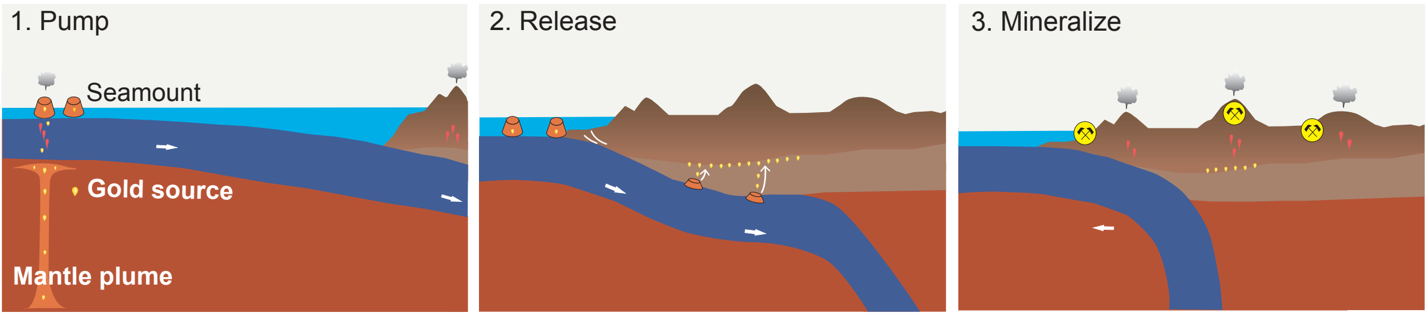
First, mantle plumes transport gold from Earth’s deep mantle into newly formed seamounts. Second, when these seamounts are eventually carried into subduction zone, the gold they contain is released into the overlying continental crust. Finally, magmatism and hydrothermal fluids generated during and after subduction concentrate the released gold into rich ore deposits within Earth’s shallow crust.(Image by WAN Bo)
Contact:
Prof. WAN Bo
Institute of Geology and Geophysics, Chinese Academy of Sciences
E-mail:wanbo@mail.iggcas.ac.cn


