An international team led by CHEN Ling and LAN Haiqiang at IGGCAS has used seismic imaging to identify two slab tears beneath the Zagros–Makran transition zone. The tears differ in both location and orientation, and the researchers propose that they were initiated by distinct geodynamic mechanisms before jointly reshaping the regional stress field and mantle flow, with implications for tectonic deformation and magmatic activity along the orogenic belt. The study was published in Nature Geoscience.
The transition from oceanic subduction to continental collision is a fundamental process in plate tectonics, yet it is rarely observed directly. Such observations require a region where the two processes are occurring at the same time—a setting found in only a few places on Earth. The Tethyan domain is one of them, and the Zagros–Makran transition zone offers a rare opportunity to observe the process as it happens.
The team deployed a temporary broadband seismic array across the transition zone, comprising one main profile and five supplementary profiles. Using nearly 18 months of teleseismic waveform data collected between 2017 and 2018, they obtained approximately 57,000 P- and S-wave travel-time measurements across multiple frequency bands. They then applied finite-frequency travel-time tomography to reconstruct the three-dimensional seismic velocity structure of the upper mantle beneath the region.
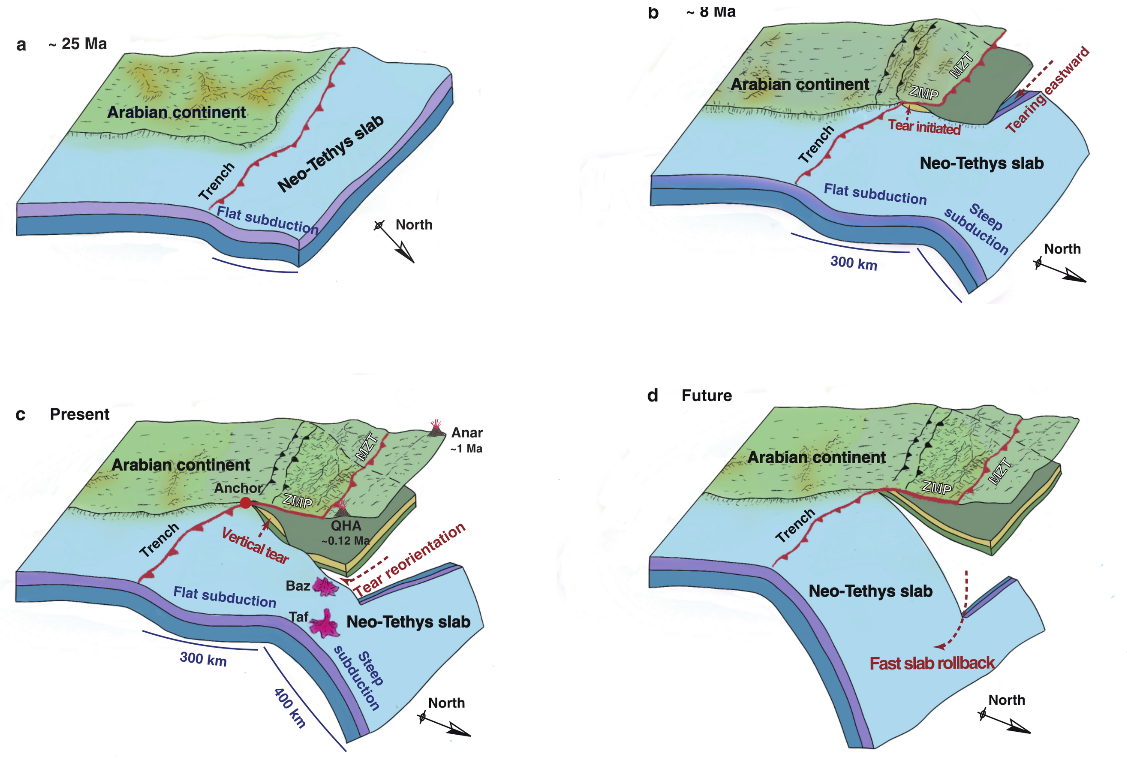
Fig. 1. Evolutionary model of double slab tearing during the Neo-Tethyan subduction–collision transition. Panels (a–d) illustrate the proposed scenarios at approximately 25 Ma, 8 Ma, the present day, and a possible future stage, respectively. (Image by CHEN's group)
The resulting images reveal striking differences in slab geometry and continuity between the eastern and western parts of the region. Beneath Makran in the east, the oceanic slab forms a roughly 300-km-long, low-angle segment beneath the forearc, then steepens beneath the volcanic arc and extends continuously to a depth of at least 450 km. Beneath Zagros in the west, by contrast, the continental lithosphere reaches depths of only about 300 km. Below it lies a remnant of ancient oceanic slab, separated from the overlying continental slab by roughly 100 km. These contrasting structures place key constraints on slab tearing during the transition from oceanic subduction to continental collision (Fig. 1).
For the tear beneath Zagros, the researchers propose that the originally connected oceanic and continental lithosphere entered the subduction zone in succession. The denser oceanic portion continued to sink into the mantle, while the more buoyant continental portion resisted further descent. This differential motion initiated a nearly horizontal tear along the subducted ocean–continent transition, which then propagated laterally and eventually produced a slab window separating the shallower continental slab from the deeper oceanic slab.
A second tear lies near the junction between the Zagros–Makran transition boundary and the Makran trench. A low-velocity anomaly separates the adjacent oceanic and continental slabs there, suggesting a vertical slab tear. Unlike conventional tearing models, which are dominated by trench retreat, the researchers propose that this tear was triggered by the continued northward advance of the Zagros collision front, which progressively lengthened the transition boundary. On the basis of regional tectonic evolution and plate-motion constraints, they infer that the vertical tear initiated about 8 million years ago and propagated roughly 200 km southward.
The study suggests that the two tears initiated at different locations and orientations and jointly facilitated the progressive decoupling of the continental lithosphere to the west from the oceanic lithosphere to the east. Notably, seismic imaging reveals a locally continuous high-velocity anomaly between the two tears, indicating that a connecting segment of lithosphere may still remain. Such a connection could help maintain low-angle subduction beneath Makran while limiting slab rollback. In addition, the slab windows created by tearing may have provided pathways for hot asthenospheric mantle to rise, potentially influencing regional magmatic activity since the late Miocene.
The study proposes an evolutionary model in which nearly horizontal and vertical slab tears develop together in the absence of significant trench retreat. It offers new insights into the progressive separation of oceanic and continental lithosphere during the early stages of the subduction–collision transition. The resulting slab segmentation may reorganize the forces acting on the subducting lithosphere and the surrounding mantle flow, providing key seismic constraints on the contrasting tectonic evolution of orogenic belts.
Research article: Lan, H., Guo, G., Chen, L. et al. “Seismic evidence for double slab tears at the Neo-Tethyan subduction–collision transition.” Nature Geoscience (2026). DOI: 10.1038/s41561-026-02129-4.
Contact:
Prof. CHEN Ling
Institute of Geology and Geophysics, Chinese Academy of Sciences
E-mail: lchen@mail.iggcas.ac.cn


