The solar wind is the primary carrier of volatiles throughout the solar system. Lunar regolith, which has been directly exposed to the solar wind for billions of years, serves as a natural archive of solar wind-derived volatiles. Noble gases (He, Ne, Ar, Kr, Xe), owing to their chemical inertness, are particularly reliable tracers for investigating solar wind implantation and its subsequent modification. Previous studies of Apollo, Luna, and Chang'e-5 (lunar nearside) samples established that lunar volatiles are derived primarily from solar wind implantation, with additional contributions from meteorite and cometary impacts. However, a longstanding question has remained unresolved: because the Moon is tidally locked to Earth, the lunar nearside periodically passes through Earth's magnetosphere, while the farside is never shielded by it. Does this orbital geometry produce systematic differences in solar wind implantation between the two hemispheres? The absence of farside samples has, until now, prevented direct experimental verification of this hypothesis.
China's Chang'e-6 mission successfully returned 1.935 g of regolith from the South Pole–Aitken Basin on the lunar farside, providing the first opportunity to directly compare solar wind implantation processes between the lunar nearside and farside.
Against this background, Dr. ZHANG Xuhang, a postdoctoral researcher at IGGCAS, under the supervision of Prof. HE Huaiyu, in collaboration with the University of Science and Technology of China and the Chang'e-7 volatile payload team, conducted a systematic noble gas isotopic investigation of Chang'e-6 regolith samples. Using stepwise-heating and total-fusion laser extraction techniques, the team precisely determined the concentrations and isotopic compositions of He, Ne, Ar, Kr, and Xe, with particular emphasis on comparing the release characteristics of the heavy noble gases Kr and Xe between Chang'e-5 (nearside) and Chang’e-6 (farside) samples.
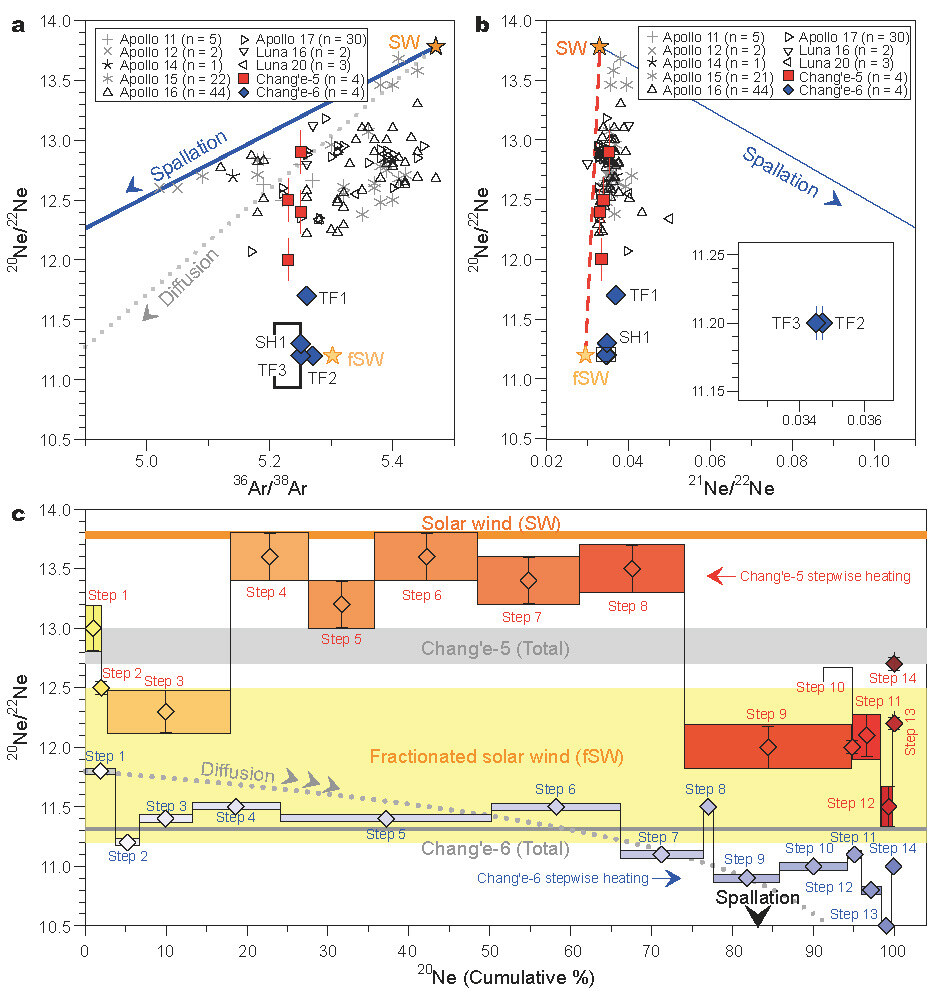
Figure 1: Comparison of Ne isotopic compositions between Chang'e-6 and nearside lunar soils.
The results reveal that the Ne isotopic composition of the Chang’e-6 regolith is highly distinctive. The average 20Ne/22Ne ratio is 11.34 ± 0.22, substantially lower than those reported for all previously analyzed nearside lunar samples and remarkably close to the theoretical strongly fractionated solar wind (fSW) endmember (~11.2). This finding indicates that the lunar farside experienced stronger isotopic fractionation, resulting in preferential enrichment of the heavier isotope. Existing models based solely on sputtering, diffusion, or surface erosion cannot fully explain for Ne ratios, suggesting that additional fractionation mechanisms—or a previously unrecognized low-Ne endmember—may exist on the lunar farside.
The release behavior of Kr and Xe also differs markedly from that of nearside samples. In the stepwise-heating experiments, solar wind-derived Xe in the Chang'e-6 regolith was released predominantly at high temperatures, producing a single high-temperature release peak. In contrast, Chang'e-5 samples exhibited a distinct double-peaked release pattern, with significant Xe release occurring at both low and high temperatures (Figure 2). Because heavy noble gases such as Kr and Xe exhibit negligible diffusion within lunar mineral grains, their release temperatures directly reflect their original implantation depths. The predominance of high-temperature release in the Chang'e-6 samples therefore demonstrates that solar wind ions penetrated significantly deeper into the farside regolith than into the nearside regolith, implying that the farside was exposed to higher-energy solar wind particles.
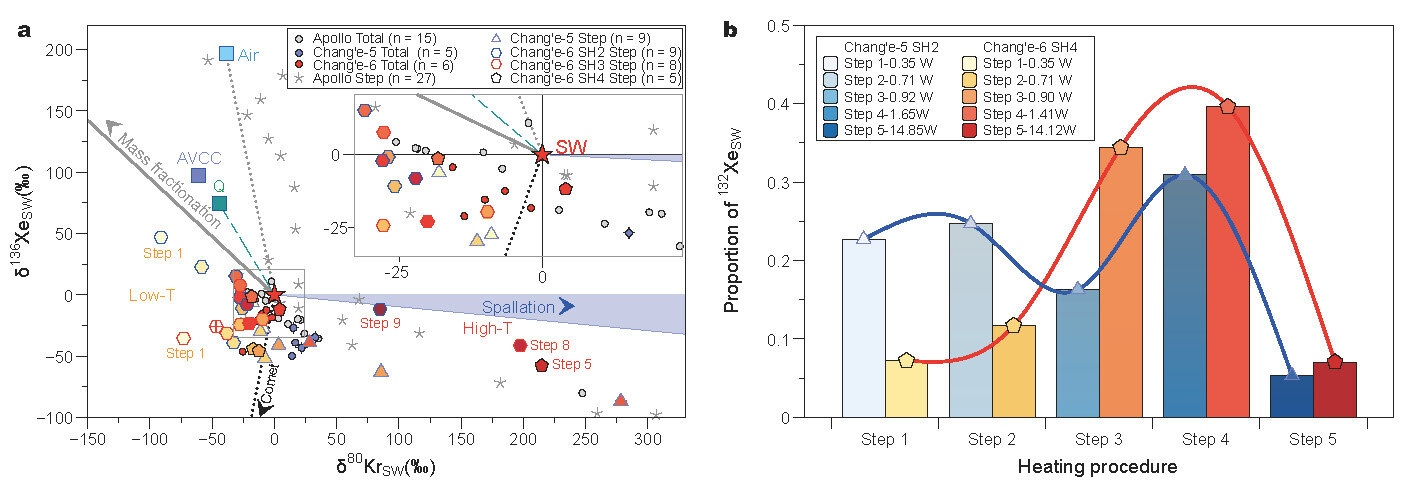
Figure 2: Comparison of solar wind-derived Kr and Xe release patterns between Chang’e-6 and Chang’e-5 regolith samples. Chang’e-6 exhibits a single high-temperature Xe release peak, while Chang’e-5 displays a distinct double-peaked pattern, indicating a shallower implantation of slower solar wind particles on the lunar nearside.
Why does the same Moon receive solar wind with different energies on its two hemispheres? The study attributes this contrast to the "speed-governing" effect of Earth's magnetosphere. As the Moon orbits Earth and traverses the magnetosheath, the ambient solar wind is significantly decelerated from its typical velocity of approximately 400 km/s to about 200 km/s. This decelerated solar wind preferentially irradiates the lunar nearside, resulting in shallower implantation depths within nearside regolith. In contrast, the farside, which permanently faces away from Earth, remains continuously exposed to the undisturbed solar wind, allowing ions to penetrate more deeply into the regolith (Figure 3).
Quantitative estimates indicate that approximately 25% of the total solar wind exposure at the Chang'e-5 landing site was influenced by this decelerated slow solar, whereas the Chang'e-6 landing site experienced no such shielding effect. SRIM ion implantation simulations further demonstrate that solar wind particles travelling at approximately 200 km/s produce implantation depths consistent with the shallow noble gas release observed in Chang'e-5 samples. At these reduced velocities, solar wind-derived noble gases are more readily mixed with meteoritic and cometary components, consistent with compositional characteristics of the Chang'e-5 regolith.
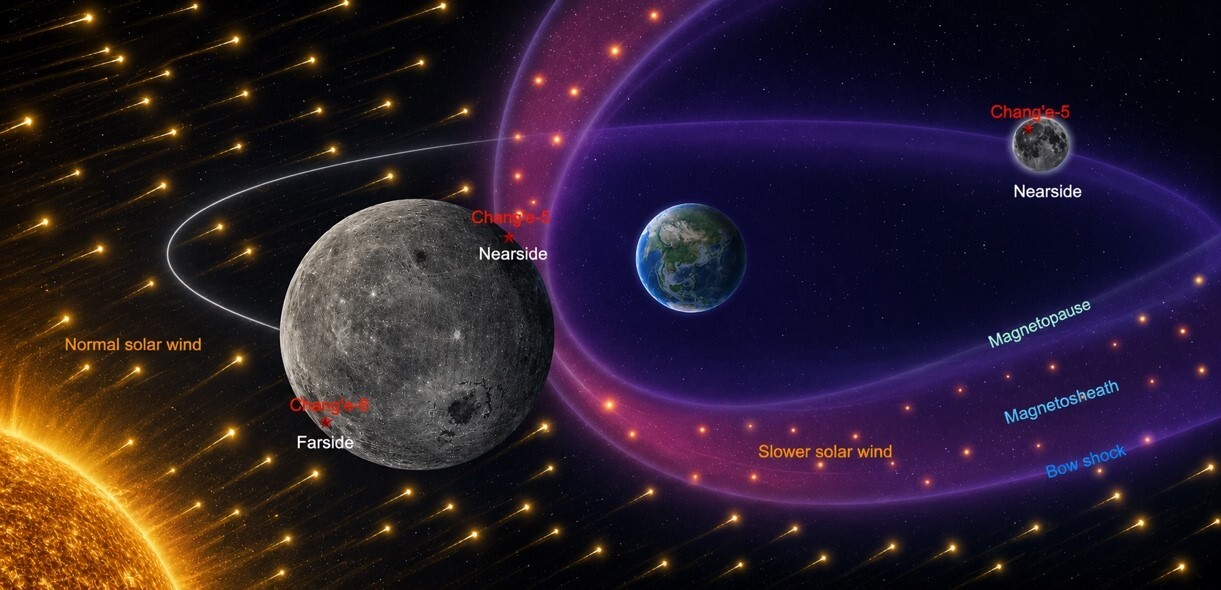
Figure 3: Schematic illustration of the contrasting solar wind environments experienced by the lunar nearside and farside under the influence of Earth's magnetosphere.(Image by ZHANG Xuhang)
In summary, this study provides the first direct empirical evidence, based on lunar farside samples, for the "speed-governing" effect of Earth's magnetosphere on solar wind implantation into the lunar surface. This effect is permanently preserved in both the implantation-depth distributions and isotopic signatures of noble gases within the lunar regolith. The findings further suggest that heavy noble gases in lunar soils may serve as "fossil records" of past interactions between Earth's magnetosphere and the solar wind, offering a novel approach for reconstructing the long-term evolution of Earth's magnetosphere in conjunction with paleomagnetic records. More broadly, the results demonstrate that interactions within the Sun–Earth–Moon system are considerably more complex than previously recognized. Comparative noble gas records from the lunar nearside and farside are revealing a new dimension of these ancient interactions, showing that even Earth's nearest celestial neighbor continues to preserve previously unknown records of planetary evolution.
This research has been published in Nature Geoscience.
Contact:
Dr. ZHANG Xuhang
Institute of Geology and Geophysics, Chinese Academy of Sciences
E-mail: xuhangzhang@mail.iggcas.ac.cn


