Sulfur is a key element that influences whether a planet can support life. On Venus, sulfur dioxide clouds dominate the atmosphere, while on Mars, sulfate minerals blanket much of the surface. Earth, however, has avoided the excessive accumulation of sulfurdespite billions of years of geological activity. How has our planet maintained this balance?
An international research team led by Prof. LI Jilei from IGGCAS, in collaboration with Yale University, Freie Universität Berlin, and University College London, has provided the first quantitative answer to this question. Their findings were published in PNAS on July 8.
The prevailing view is that Earth maintains a dynamic sulfur cycle between its deep interior and surface through plate tectonics. Volcanic activity transports sulfur from the mantle to the surface, while subduction zones recycle sulfur-bearing materials back into the mantle. However, one fundamental question has remained unresolved: Is Earth’s deep sulfur cycle globally balanced?
Previous studies have provided clear answers for other volatile cycles. Earth's deep water cycle is significantly imbalanced, with more water entering the mantle than returning to the surface, whereas the deep carbon cycle appears to be approximately balanced. In contrast, the deep sulfur cycle has lacked robust quantitative constraints.
One major challenge lies in estimating sulfur input into the mantle. Most previous studies relied on global average values for sediment thickness and sulfur content, although these parameters vary substantially among subduction zones. Such averaging obscures regional variability and introduces considerable uncertainty into global flux estimates. Estimating sulfur output presents a similar challenge because sulfur emissions from individual volcanic arcs vary widely, making global extrapolations difficult.
To address these limitations, the research team divided the global subduction system into 32 individual subduction zones, including 19 erosive and 13 accretionary margins, and quantified the key parameters controlling sulfur flux for each zone separately.
Their study introduced three methodological advances.
First, the researchers systematically compiled data from more than 1,500 scientific ocean drilling sites from the DSDP, ODP, IODP programs to establish the first comprehensive global dataset of sedimentary sulfur contents for individual subduction zones. They found that the average sulfur concentration of globally subducting sediments is approximately 2,450 μg/g, significantly lower than the commonly adopted reference value of 6,000 μg/g in previous studies. This revision has important implications for estimating global sulfur fluxes.
Second, using 234 seismic reflection profiles, the team constructed a global dataset of oceanic crustal thickness for all 32 subduction zones. Crustal thickness ranges from 4.6 to 9.7 km, with a global average of 6.5 km.
Third, the researchers systematically quantified the thickness of serpentinized mantle beneath different types of subduction zones for the first time. They found that erosive margins contain an average of approximately 3.1 km of serpentinized mantle, while accretionary margins contain only about 0.27 km—an order of magnitude difference.
Based on these datasets, the team calculated that the total sulfur flux entering the Earth’s mantle through subduction is 57 ± 3 Mt/yr. Subducting oceanic crust accounts for approximately 71% of this flux, sediments contribute about 22%, and serpentinized mantle contributes the remaining 7%.
The analysis also revealed pronounced regional variability. Accretionary subduction zones, such as the Sunda and Japan margins, account for approximately 75% of the global sulfur input from sediments, while individual erosive margins, including Central America and Chile, generally contribute an order of magnitude less. Owing to their exceptional lengths, the Solomon Islands and Java subduction zones represent major global hotspots of sulfur input.
To estimate sulfur output from the mantle, the researchers comprehensively evaluated contributions from three major tectonic settings. Arc volcanism releases approximately 18.4 ± 11 Mt/yr, with roughly 70% emitted as volcanic gas (primarily SO₂) and the remaining 30% retained in volcanic rocks. Mid-ocean ridges contribute approximately 35.7 ± 9 Mt/yr, with nearly all sulfur incorporated into newly formed oceanic crust because the high pressures of the deep ocean suppress volcanic degassing. Intraplate magmatism, including hotspots and continental rifts, contributes an additional 5.7 ± 1.3 Mt/yr. Together, these sources yield a total mantle sulfur output of 60 ± 14 Mt/yr.
Comparison of the global input and output fluxes shows that sulfur enters the mantle at 57 ± 3 Mt/yr and returns to the surface at 60 ± 14 Mt/yr. Because these values overlap within their respective uncertainties, the results indicate that Earth's deep sulfur cycle is currently in a near-steady-state balance.
This global balance does not imply that every subduction zone behaves similarly. The efficiency of sulfur recycling efficiency, defined as the ratio of arc sulfur output to slab sulfur input, varies dramatically among subduction zones, ranging from nearly 0% to almost 100%, with a global average of approximately 37%. Moreover, the researchers found no linear relationship between slab sulfur input and the sulfur content of arc magmas, suggesting that sulfur enrichment in arc magmas is also controlled by factors such as melt production, oxygen fugacity, slab thermal structure, and other geological processes.
The study also uncovered systematic sulfur isotope fractionation during subduction. Sulfur entering the mantle through subducting slabs generally exhibits negative δ³⁴S values (−13‰ to +1‰), while arc magmas and volcanic gases display predominantly positive δ³⁴S values (+1‰ to +9‰). This characteristic "negative in, positive out" pattern is observed across nearly all subduction zones, indicating that the sulfur isotope composition of arc magmas is not simply inherited from subducted materials but is extensively modified during sulfur recycling.
Beyond advancing our understanding of Earth's deep sulfur cycle, the findings also have important implications for planetary habitability. The near-steady-state balance of sulfur exchange between Earth’s surface and interior may represent a fundamental process that has helped maintain the planet’s long-term habitability, preventing sulfur from accumulating to the extreme levels observed on Venus or becoming permanently sequestered as on Mars (Fig. 1).
The authors note, however, that this balance may not have persisted throughout Earth's history. During much of the Phanerozoic, thinner sediment cover on the seafloor would have reduced sulfur input through subduction, while higher mantle temperatures likely enhanced volcanic activity and sulfur outgassing. Consequently, the deep sulfur cycle may have operated in a net output state during earlier geological periods. Understanding how Earth’s sulfur cycle evolved through time may therefore help explain why Earth, Venus, and Mars followed markedly different evolutionary trajectories.
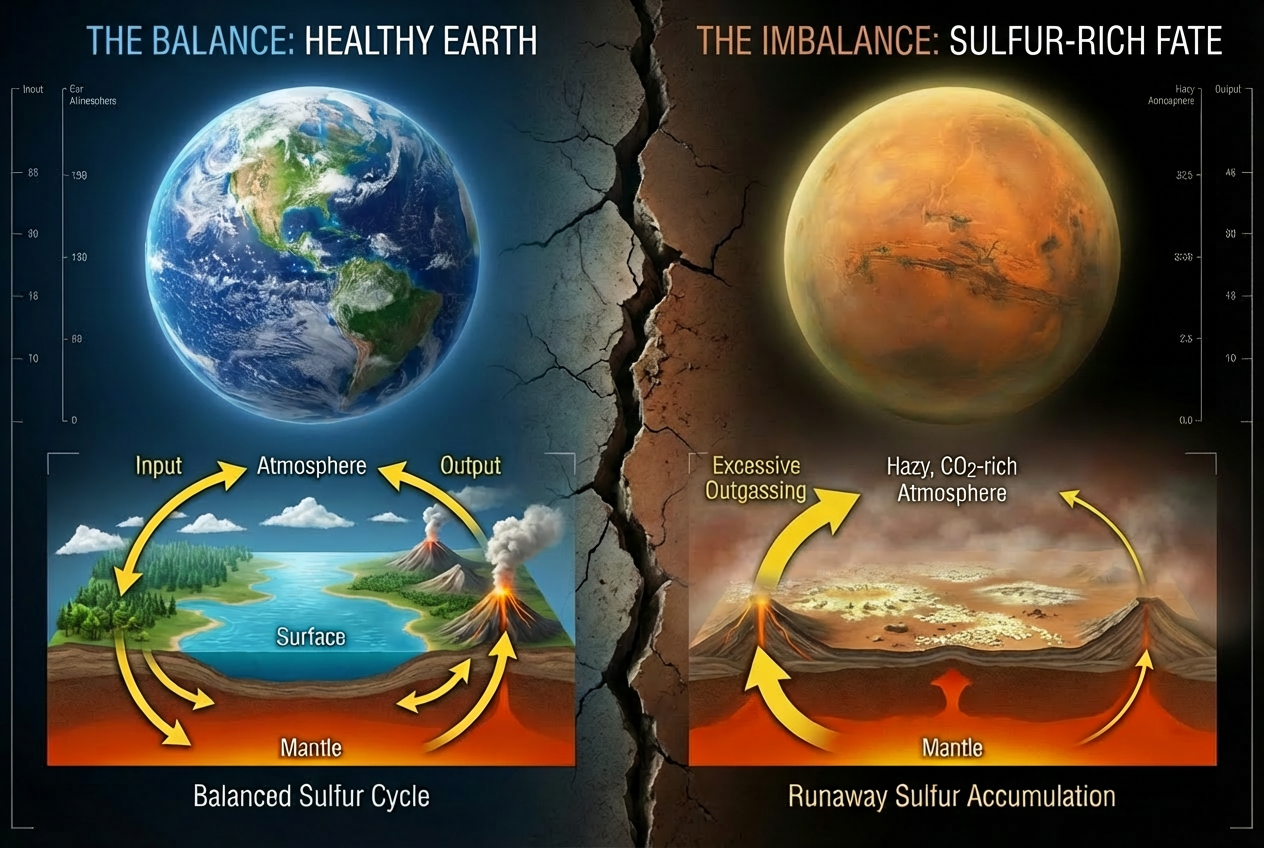
Figure 1: Conceptual comparison of the balanced deep sulfur cycle on habitable Earth and the imbalanced sulfur cycle on uninhabitable Mars (AI-generated).
Contact:
Prof. LI Jilei
Institute of Geology and Geophysics, Chinese Academy of Sciences
E-mail: lijilei@mail.iggcas.ac.cn


