An international research team led by LU Kai, FENG Lianjun, and Ross Mitchell of IGGCAS, has provided the first direct constraints on ocean temperatures during the Cryogenian "Snowball Earth" period, approximately 700 million years ago. Their study, published in Nature Communications, indicates that seawater along continental margins reached temperatures as low as -15°C, accompanied by salinities approximately four times higher than those of modern oceans.
"Snowball Earth" describes a series of extreme glaciation events during which ice sheets are thought to have extended from the poles to equatorial regions. Although such conditions imply extremely low temperatures, quantitative estimates of seawater temperature during this interval have remained scarce.
The authors derived temperature estimates by analyzing iron isotope compositions in Cryogenian iron formations—chemical sedimentary rocks commonly used in modern steel production. Iron isotopes were employed as a paleothermometer, based on experimentally calibrated temperature-dependent fractionation. The data exhibit a systematic isotopic enrichment consistent with very low temperatures. As noted by lead author LU Kai, progressively colder conditions correspond to increasingly positive iron isotope fractionation.
Despite the extreme thermal regime, the study suggests that seawater remained locally unfrozen owing to exceptionally high salinity, which lowered the freezing point to approximately -11°C. Such conditions are interpreted to have developed beneath thick ice shelves, analogous to modern Antarctic "ice pump" systems.
These results provide the first quantitative evidence for extreme, spatially heterogeneous oceanic conditions during Snowball Earth glaciations. The findings demonstrate how liquid seawater could persist beneath extensive ice cover and offer new constraints on the environmental conditions that may have allowed early life to survive during one of the most severe climate states in Earth's history. Life, however, would have had to endure and adapt to the extreme conditions indicated by the new study. Supporting this scenario, bacteria have been found thriving in similarly cold, salty brines under the ice of Antarctica's Lake Vida.
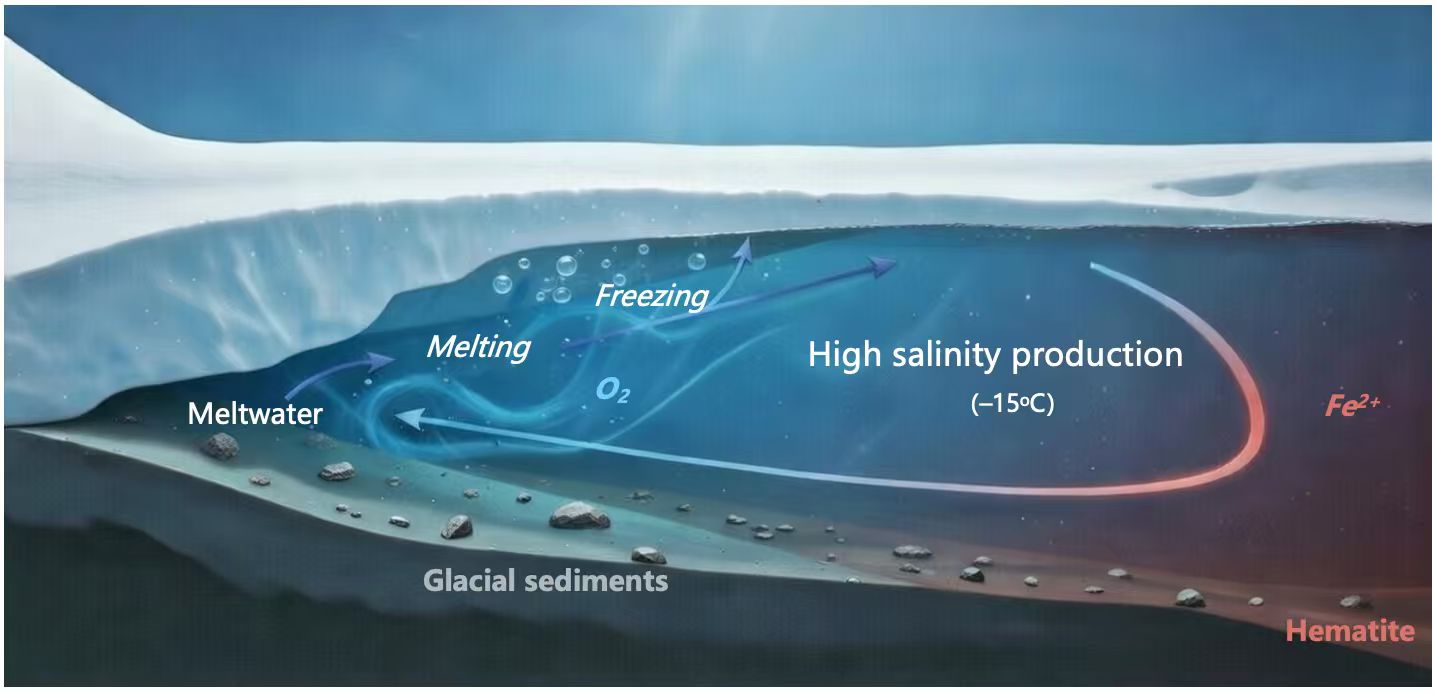
A Conceptual model of Cryogenian iron formation deposition and high-salinity brine generation during Snowball Earth conditions (Image courtesy of LU Kai's research group)
Contact:
Prof. Ross Mitchell
Research Center of Lithospheric Evolution, IGGCAS
E-mail: ross.mitchell@mail.iggcas.ac.cn


