In the early Solar System, asteroids and comets acted as "couriers", continuously delivering organic matter, along with key bioessential elements such as carbon, nitrogen, oxygen, phosphorus, and sulfur, to terrestrial planets. These exogenous materials may have supplied some of the chemical ingredients necessary for the origin and early evolution of life on Earth. However, due to extensive geological activity and biological processes, direct records of these early inputs have largely been erased on Earth. In contrast, the Moon, with its relatively limited geological activity, serves as a natural “time capsule” that is more likely to preserve evidence of the delivery and subsequent evolution of extraterrestrial organic matter.
A recent study led by Senior Engineer HAO Jialong from IGGCAS, in collaboration with researchers from the University of New Mexico, Changsha University of Science and Technology, and other institutions, has, for the first time, systematically identified multiple nitrogen-bearing organic species on the surfaces of lunar soil grains returned by the Chang’e-5 and Chang’e-6 missions. The study further reveals an evolutionary pathway characterized by “exogenous delivery–impact modification–continuous solar wind processing.” The results demonstrate that the Moon not only records the history of organic delivery from asteroids and comets to the inner Solar System, but also preserves evidence of subsequent modification of these materials by impacts and irradiation on an airless body. The study was published online in Science Advances on April 9, 2026 (Beijing time).
Although carbon and nitrogen had previously been detected in Apollo lunar soils, the existence, morphology, origin, and preservation mechanisms of nitrogen-bearing organic matter in lunar regolith remained poorly constrained. In this study, lunar soil grains returned by the Chang’e-5 and Chang’e-6 missions were selected for analysis. The researchers conducted correlative investigations using multiple microscopic and spectroscopic techniques to systematically characterize the morphology, chemical bonding and functional groups, and stable isotopic compositions of the organic matter.
DONG Mingtan, a Ph.D. candidate at IGGCAS and the first author of the study, reported that organic matter on lunar soil surfaces predominantly occurs in three forms—particle-like, adhering, and inclusion-like—at submicrometer to micrometer scales (Fig. 1) and commonly contains inorganic mineral particles typical of lunar soil. Chemically, these materials are dominated by carbon, nitrogen, and oxygen and are generally amorphous in structure; amide functional groups were also identified in some samples. These observations indicate that the lunar organics are not merely graphitized carbon but have undergone more complex chemical reorganization.
Further analysis revealed that the hydrogen, carbon, and nitrogen isotopic compositions of these lunar organics are generally lighter than those reported for organic matter in carbonaceous chondrites and asteroid samples. This isotopic signature is consistent with evaporation–condensation and redeposition processes induced by impact events. Specifically, impacts by asteroids, comets, and other extraterrestrial bodies not only delivered organic materials to the lunar surface but also likely triggered their decomposition, volatilization, migration, and subsequent condensation onto mineral surfaces, forming new nitrogen- and oxygen-bearing structures (Fig. 2).

Figure 1. Representative organic matter in Chang’e-6 (A–B) and Chang’e-5 (C–D) lunar soils. Secondary electron images acquired by scanning electron microscopy overlaid with carbon elemental maps from energy-dispersive spectroscopy.(Image by HAO Jialong's Group)
The research team also identified signatures of solar wind implantation in lunar organic matter for the first time. NanoSIMS depth profiling shows that some surface-associated organics exhibit distinct variations in hydrogen isotopic composition and H/C ratios near the grain surfaces. These features indicate prolonged exposure on the lunar surface after formation or deposition, during which the materials were continuously irradiated by the solar wind. Jialong Hao, corresponding author of the study and Senior Engineer at the NanoSIMS Laboratory of IGGCAS, noted that such solar wind implantation signatures represent a characteristic “fingerprint” of solar wind-material interactions and effectively rule out the possibility of terrestrial contamination as the source of these organics.
The authors emphasize that this work also provides important technical and scientific support for future deep-space sample-return missions in China. From a technical perspective, the study establishes an analytical framework for identifying and interpreting microscale organic matter and its evolutionary processes, which can be directly applied to the analysis of organic matter and volatiles in samples returned by the Tianwen-2 mission. From a scientific perspective, the results reveal a continuous evolutionary sequence of lunar organic matter—from exogenous delivery through impact-induced restructuring, to space-weathering modification—thereby offering new insights into the evolution of small-body materials and the history of organic delivery in the early Solar System.
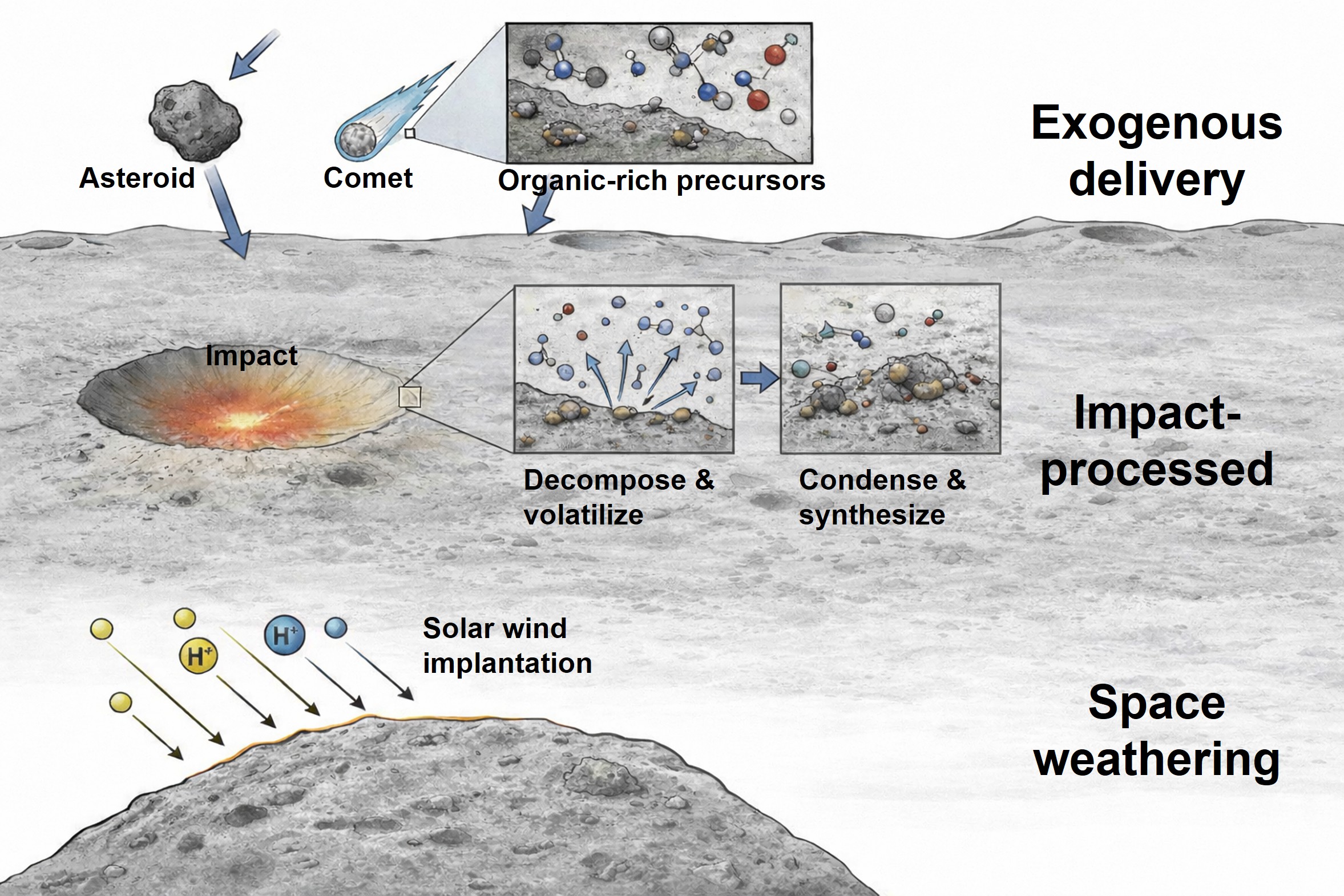
Figure 2. Schematic illustration of the formation and evolution of organic matter in lunar soil.(Image by HAO Jialong's Group)
Contact:
Senior Engineer HAO Jialong
E-mail: sean_hao@mail.iggcas.ac.cn
IGGCAS,NanoSIMS Lab


