BEIJING / SEATTLE / HOUSTON — Soil is often perceived simply "dirt," but in reality, it is a dynamic, living system that functions as the Earth's natural sponge. New research published in the journal Science shows that common agricultural practices, such as deep plowing and the use of heavy machinery—can severely disrupt this natural system, reducing soil’s ability to help crops withstand both flooding and drought.
The study, led by Dr. SHI Qibin from IGGCAS, employed a novel technique to observe subsurface soil processes without excavation. The research was conducted in collaboration with the University of Washington (UW), Rice University, Harper Adams University, the University of California, Santa Cruz (UCSC), Purdue University, and University of Exeter. The team transformed standard fiber-optic cables—similar to those used in high-speed internet networks—into a large-scale sensor array installed across an experimental farm at Harper Adams University in the United Kingdom. By detecting tiny ground vibrations generated by natural and human activities, the researchers were able to continuously monitor how water moves through soil every single minute.
The results indicate that healthy soil contains a natural internal "plumbing" network composed of microscopic pores and channels that allow water to infiltrate deeply into the ground, where it becomes available to plant roots. In fields subjected to frequent plowing or heavy tractor traffic, however, this pore network becomes severely disrupted. As a result, rainfall tends to accumulate near the surface in heavily cultivated soil. Because the water remains shallow, it evaporates rapidly under sunlight, leaving deeper soil layers dry. In contrast, undisturbed soils act as effective natural filters, rapidly absorbing water and storing it in deeper layers where plants can access it during dry periods.
To explain these observations, the researchers developed a dynamic capillary stress model. Traditional soil mechanics generally assumes that soil strength depends primarily on total water content. However, high-resolution fiber-optic observations revealed a more complex behavior. Due to the "ink-bottle effect" within soil pore structures, the capillary force that holding soil together varies depending on whether the soil is undergoing wetting or drying, even when the overall moisture content remains the same. "Rather than a simple collection of particles, soil is a porous medium in which the structure functions like capillary vessels within the water cycle," Dr. SHI explains.
These findings highlight the need to reconsider how agricultural land is managed. Excessive tillage and soil compaction caused by heavy machinery do not merely rearrange soil particles; they are breaking the invisible mechanical bonds that allow soil to breathe, circulate water and maintain ecological stability. Preserving these natural structures will be critical for helping crops adapt to the increasingly extreme weather conditions brought by climate change.
The research introduces a new field that the team calls "Agroseismology." This emerging approach uses distributed fiber-optic sensing to assess the health of soil water systems without physically disturbing the land. By "listening" to the Earth in this way, scientists and farmers may soon be able to diagnose the condition of agricultural soils in real time and develop more resilient strategies for sustainable food production.
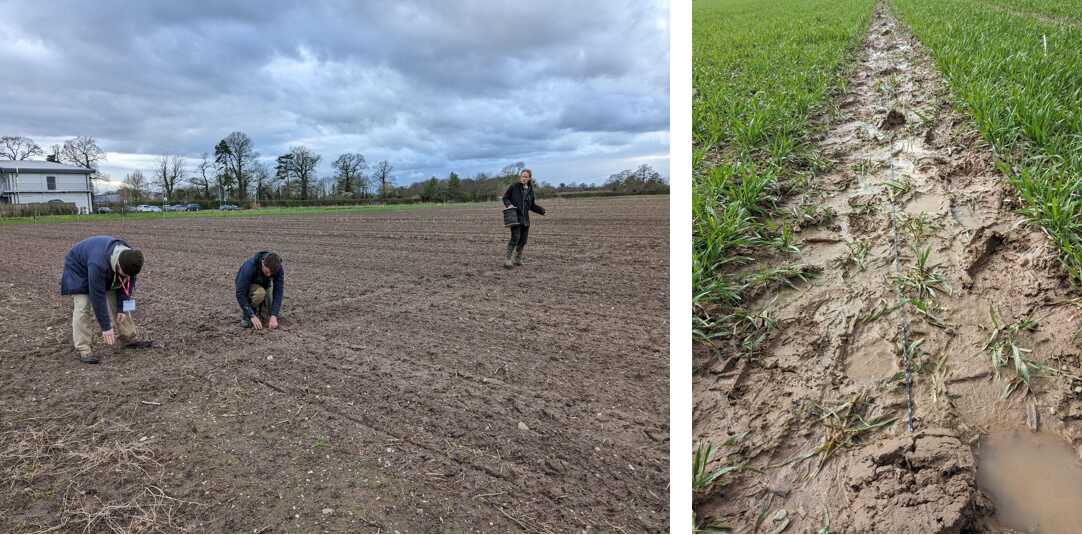
Deployment of fiber-optic cable (left) and the soil condition near the cable. (Credit: Marine Denolle)
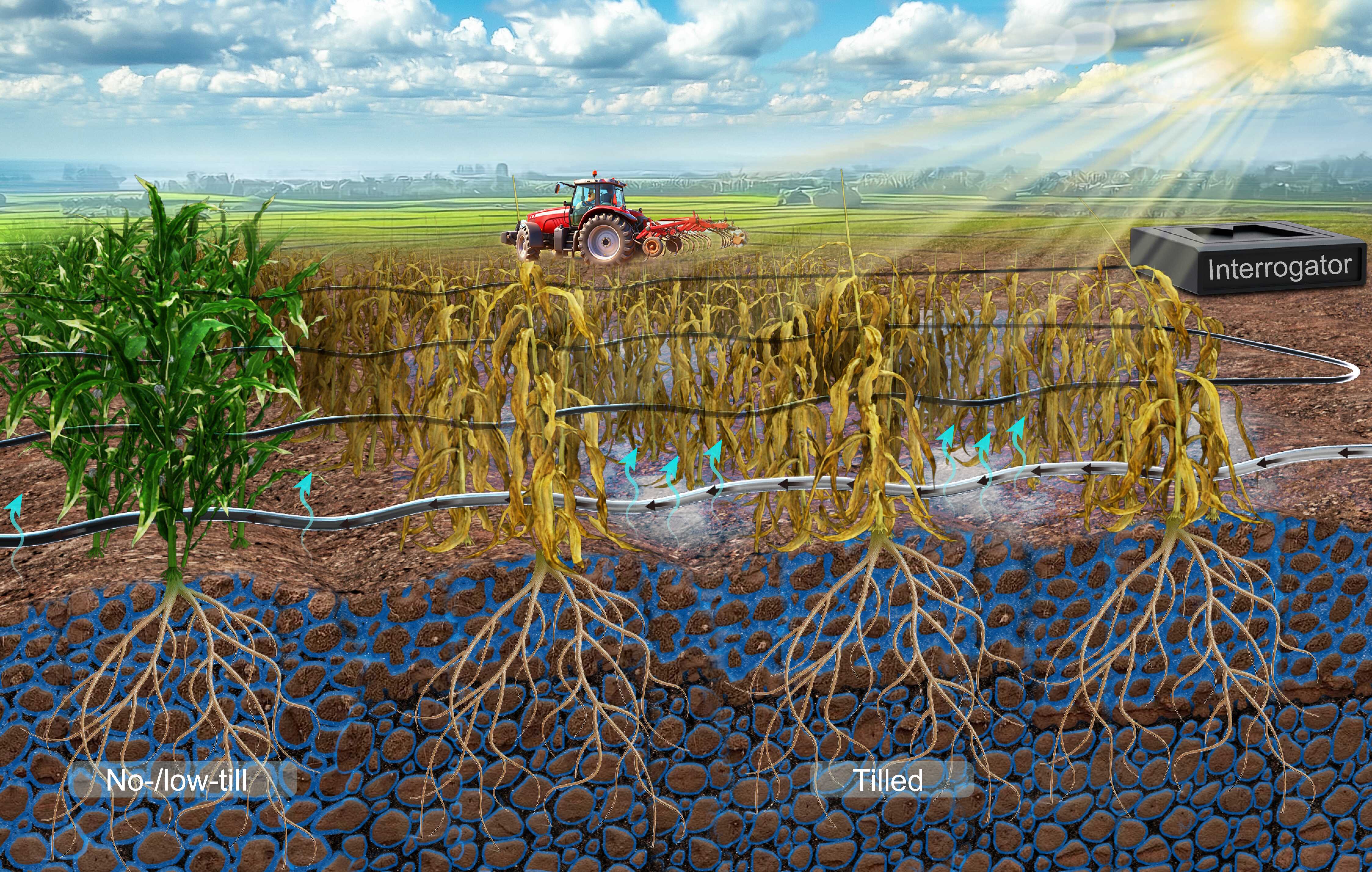
Impact of farming practices on soil porous structure and hydrological process revealed by distributed acoustic sensing.(Image by IGGCAS)
Contact:
Associate Professor SHI Qibin
lnslitute of Gedlogy and Geophysics, Chinese Academy of Sciences
E-mail: qshi@mail.iggcas.ac.cn


