On February 5, 2026, Beijing time, scientists from the Institute of Geology and Geophysics, Chinese Academy of Sciences (IGGCAS) , the Aerospace Information Research Institute, Chinese Academy of Sciences (AIRCAS), and other institutions, based on samples from the far side of the Moon collected by Chang'e-6, combined with remote sensing imagery, revised the lunar crater chronology model that has been used for decades. They have, for the first time, confirmed that the meteorite impact flux on the Moon's near and far sides is essentially consistent. Their findings indicate that the early impact flux declined smoothly over time, providing no support for the "Late Heavy Bombardment" hypothesis. The related research was published in Science Advances.
Impact craters are the dominant geomorphic features on the lunar surface and record the cumulative effects of meteorite bombardment since the Moon’s formation. Early telescopic observations by Galileo first recognized these features, and subsequent improvements in imaging resolution revealed a systematic relationship between crater density and surface age. Following the return of lunar samples by the Apollo and Luna missions, this relationship was quantitatively calibrated through the development of a lunar cratering chronology function (CF), which links crater density to absolute radiometric age. This function has since formed the foundation of lunar geological studies, enabling age estimates for regions lacking returned samples.
Prior to the Chang’e-6 mission, however, all samples used to calibrate the lunar CF were derived from the nearside of the Moon. This limitation raised concerns regarding its global applicability, as some studies proposed that the impact flux may differ between the nearside and farside. In addition, a long-standing debate surrounds the nature of early lunar impact history. Many Apollo samples contain impact-related materials with ages clustered near approximately 3.9 billion years, which led to the formulation of the Late Heavy Bombardment (LHB) hypothesis, proposing a short-lived spike in impact activity across the inner Solar System. Alternative interpretations argue that this apparent age concentration reflects sampling bias, with many of the dated materials representing ejecta from the Imbrium impact rather than a global bombardment event.
The Chang’e-6 mission provide a unique opportunity to address both issues. The spacecraft landed in the Apollo Basin within the South Pole-Aitken (SPA) Basin on the lunar farside—the largest and oldest recognized impact basin on the Moon and a key archive of its earliest history. The returned samples are dominated by local basalt with an age of ~2.807 billion years, which serves as an independent farside calibration point for assessing nearside-farside consistency in impact flux. Additionally, the samples include noritic lithologies dated to 4.247 billion years. Integrated petrological, mineralogical, and remote-sensing analyses indicate these norites represent crystallized impact melts produced during formation of the SPA basin, thereby constraining the timing of this major early impact event.
Using well-established nearside calibration points and their associated crater densities, the team first constructed a lunar cratering chronology curve and quantified its uncertainty. The Chang’e-6 farside ages and corresponding crater densities fall within the 95% confidence interval of the nearside-derived curve, indicating no resolvable difference in impact flux between the lunar nearside and farside. This result supports the applicability of a unified global cratering chronology and challenges earlier suggestions of enhanced farside bombardment.
Then, they established an updated lunar cratering chronology function by incorporating all reliable control points, including those provided by Chang’e-6. The inferred impact flux evolution exhibits a smooth and rapid decline during early lunar history, rather than a pronounced spike at ~3.9 billion years ago. Notably, the 4.247-billion-year-old Chang’e-6 is inconsistent with both the LHB model and alternative sawtooth impact-flux scenarios. These observations indicate the Chang’e-6 samples do not support the existence of a Late Heavy Bombardment at ~3.9 billion years ago, either on the Moon or across the inner Solar System, and instead favor a monotonic decay in impact activity following planetary accretion.
Beyond resolving long-standing debates on lunar impact history, the revised cratering chronology derived from Chang’e-6 data provides an improved framework for dating unsampled regions of the Moon. As such, the Chang’e-6 mission represents a critical advance in reconstructing the timing and evolution of lunar surface processes, and, more broadly, the early history of the Earth–Moon system.
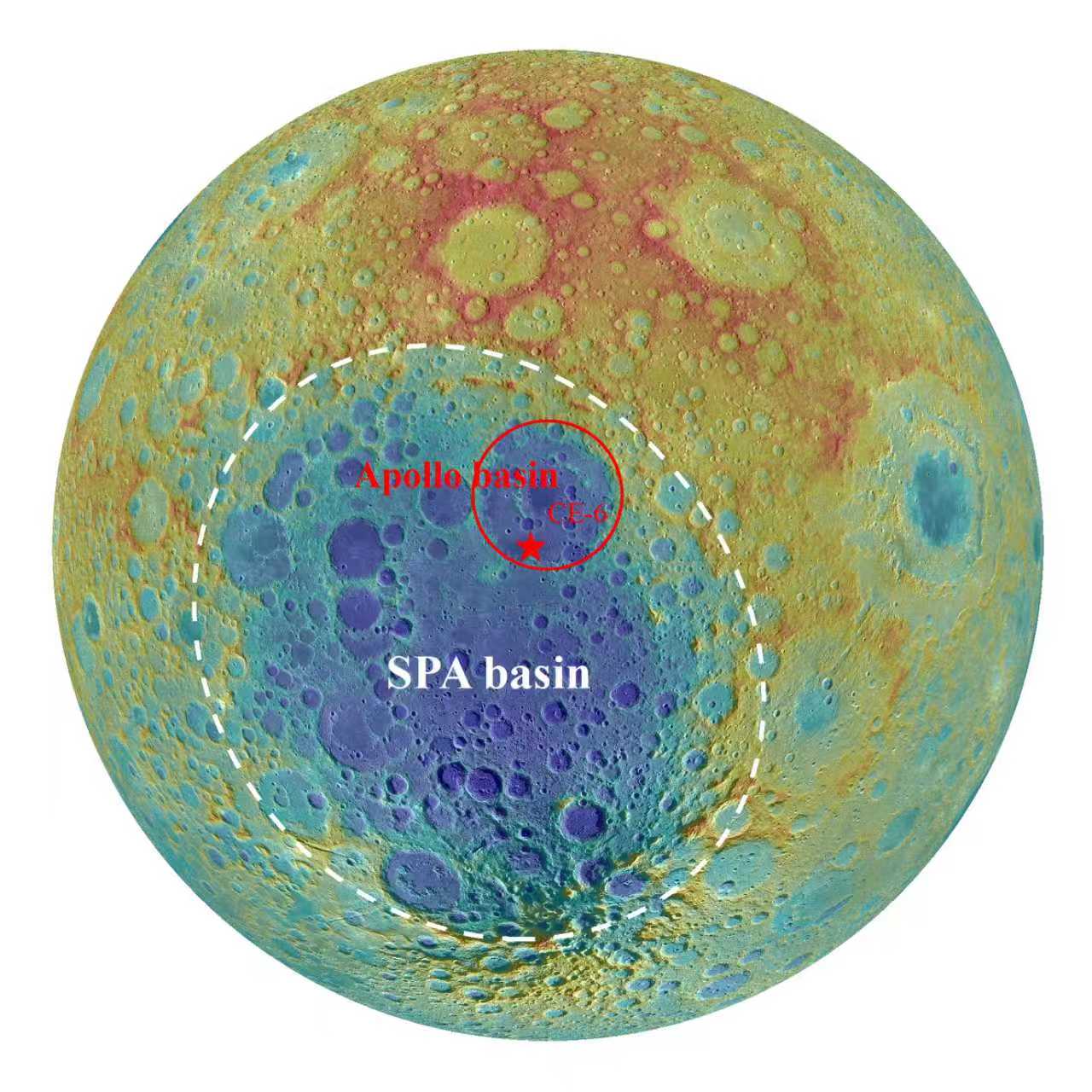
Topographic map of the lunar farside based on LRO LOLA Data (Courtesy of YUE Zongyu’s research team)
Contact:
YUE Zongyu
E-mail: yuezy@mail.iggcas.ac.cn
Institute of Geology and Geophysics, Chinese Academy of Sciences


