Lunar samples provide an essential link between orbital remote sensing and ground-truth measurements. Previous sample-return missions—Apollo, Luna, and Chang'e-5—have collectively brought back approximately 383 kg of lunar soil and rocks from the Moon's near side, greatly advancing our understanding of lunar geological evolution and regolith properties. However, the lack of samples from the far side has constrained investigations of its distinct composition and geologic history.
On 25 June 2024, China's Chang'e-6 mission successfully returned 1,935.3 g of lunar soil from the South Pole–Aitken Basin on the lunar far side—the largest, deepest, and oldest impact structure on the Moon. According to HU Hao, chief designer of the Chang'e-6 mission, the returned samples appeared "slightly more viscous and somewhat clumpier" than the relatively fine and loose material collected by Chang'e-5.
To quantify this observation, Prof. QI Shengwen and colleagues at IGGCAS, performed fixed-funnel and rotating-drum experiments to measure the angle of repose, a key parameter reflecting the flowability of granular materials. The results showed that the Chang'e-6 soil has a significantly higher angle of repose than near-side samples, displaying flow behavior characteristics of cohesive soils.
Subsequent analysis ruled out magnetic and cementation effects, as the samples contain only trace amounts of magnetic minerals and lack clay minerals. Instead, the elevated angle of repose is attributed to three interparticle forces: friction, van der Waals forces, and electrostatic forces. While friction is proportional to particle surface roughness, the contribution from van der Waals and electrostatic forces increases as particle size decreases. Using the D60 metric—the particle diameter at which 60% of the sample is finer—the researchers identified a critical size threshold of approximately 100 μm, below which fine non-clay mineral particles begin to exhibit cohesive behavior.
High-resolution CT imaging revealed that the Chang'e-6 samples have a D60 of only 48.4 μm—substantially finer and more irregular in shape than near-side soils, and with much lower particle sphericity. "This is unusual," noted Prof. Qi. "Finer particles are typically more spherical. Despite being fine-grained, the Chang'e-6 soil shows more complex particle morphologies." This may reflect the higher feldspar content of the samples (~32.6%), which is susceptible to fragmentation, combined with more intense space weathering on the far side. These textural and morphological characteristics enhance interparticle forces, generating the observed high cohesion.
This study provides the first systematic explanation of the cohesive behavior of lunar soil from a granular mechanics perspective, offering new insight into the physical properties of far-side regolith. The findings supply important scientific support for future lunar exploration, including the development of lunar bases and in-situ resource utilization. (Link)
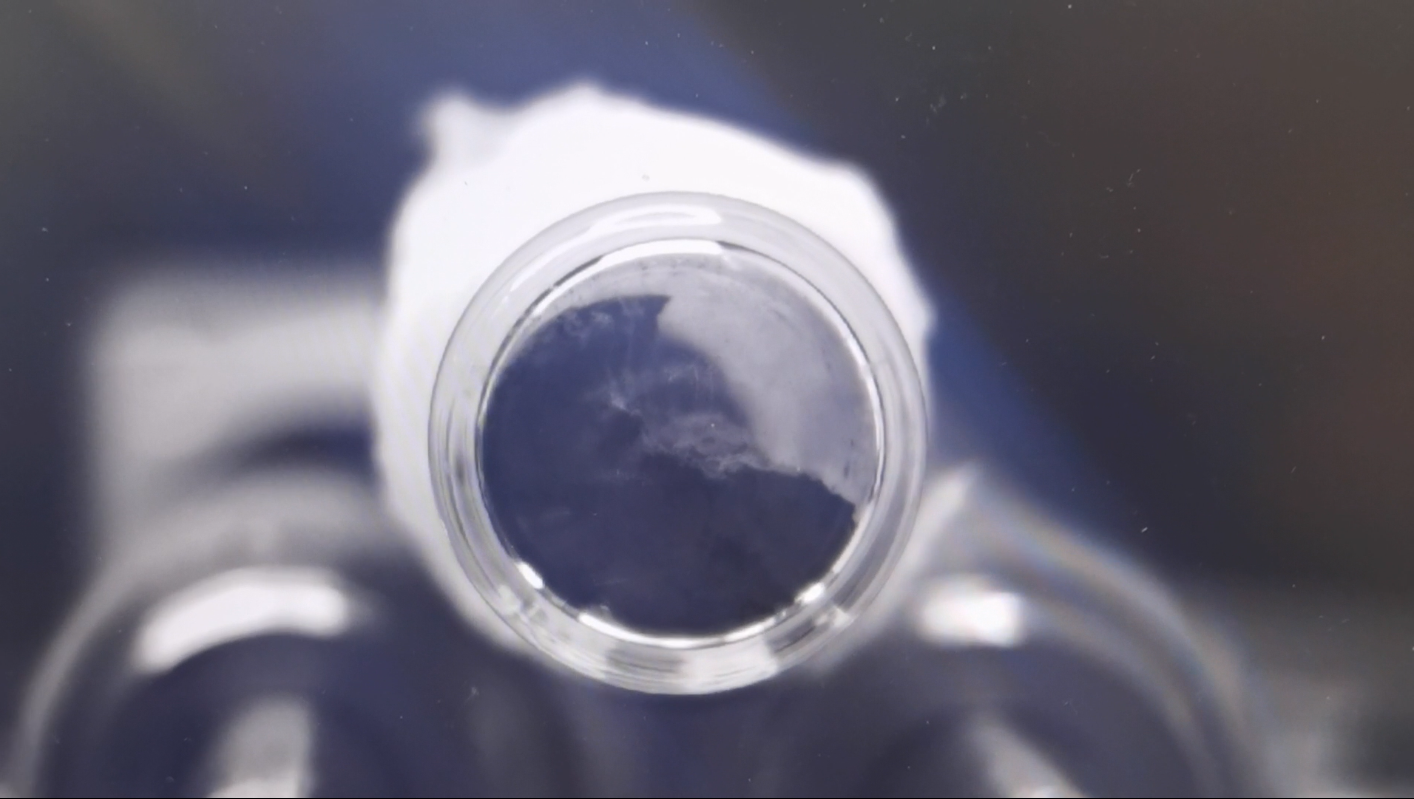
Front view of the rotating drum test.(Image by IGGCAS)
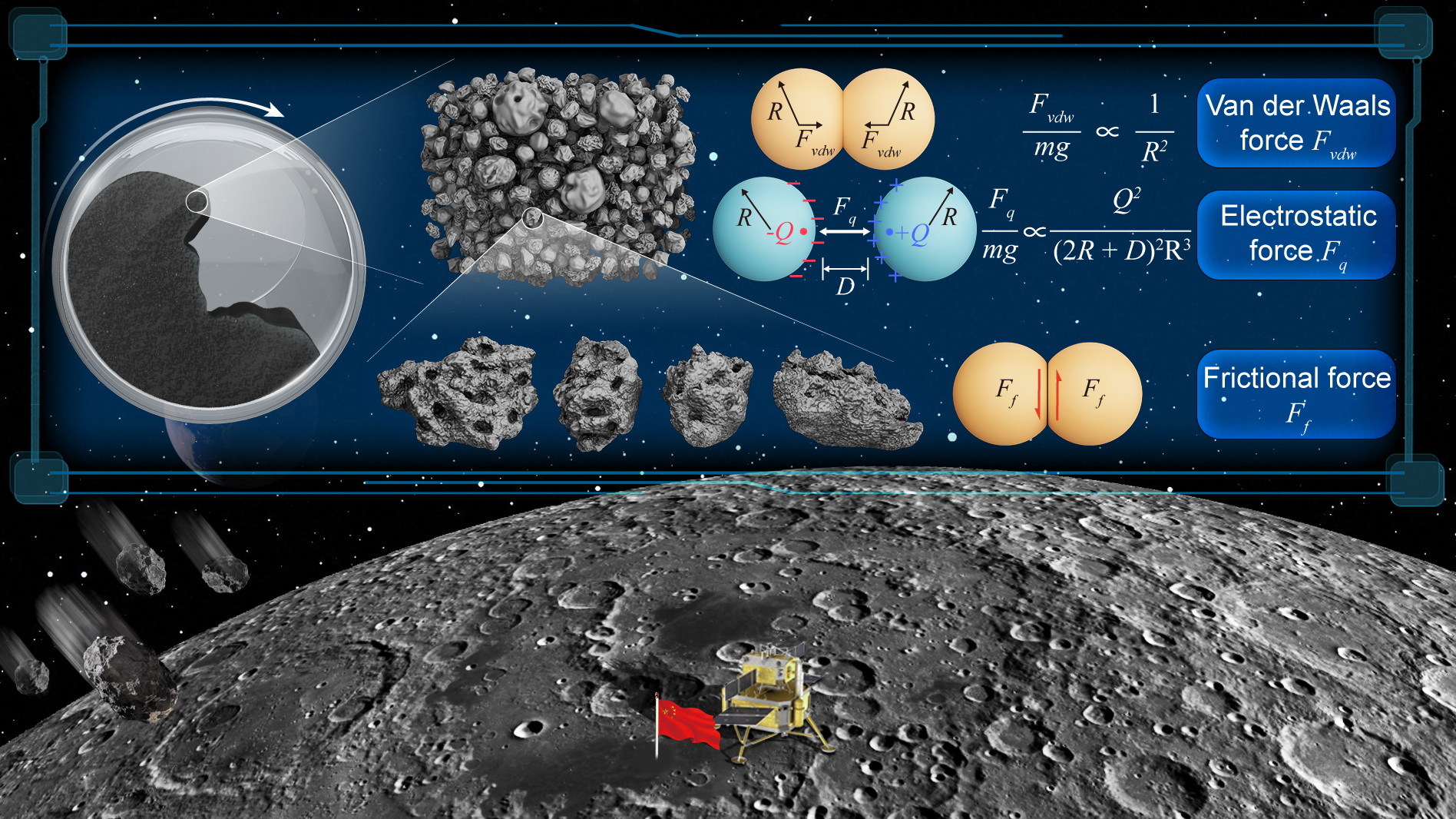
The angle of repose is fundamentally determined by three primary factors: the internal friction angle of the material, and the cohesive contributions of both van der Waals forces and electrostatic forces(Image by IGGCAS)
Contact:
Prof. QI Shengwen
Institute of Geology and Geophysics, Chinese Academy of Sciences
E-mail: qishengwen@mail.iggcas.ac.cn


