Approval has been granted by the The International Mineralogical Association Commission on New Minerals, Nomenclature and Classification (IMA-CNMNC) has officially approved for two new mineral species discovered newly identified in the Bayan Obo deposit, of Inner Mongolia, China. The newly recognized minerals, Named Zuolinite and Magnesiohongruiite-(Fe³⁺), they were assigned the approval numbers IMA 2025-058 and IMA 2025-049, respectively. These discoveredies were made and characterized by a researchers team from IGGCAS, led . They have been assigned the approval numbers IMA 2025-058 and IMA 2025-049, respectively. The research was conducted by the Center for Ore Resources of the State Key Laboratory of Lithospheric and Environmental Evolutionmental Coevolution at our institute.
The core research team included Special-term Associate Researcher She Haidong (first discoverer of Zuolinite and co-first discoverer of Magnesiohongruiite-(Fe³⁺)), Ph.D. candidate Zhan Yunxiang (co-first discoverer of Magnesiohongruiite-(Fe³⁺)), Researcher Li Xiaochun (corresponding author for Magnesiohongruiite-(Fe³⁺)), and Associate Researcher Yang Kuifeng, among others. The study was conducted inThey collaboratedion with external partners, notably Professor Gu Xiangping from Jiangxi University of Applied Science and Senior Engineers Yang Zhanfeng and Wang Qiwei from the Baotou Research Institute of Rare Earths. The identificationdiscovery of these two minerals Zuolinite and Magnesiohongruiite-(Fe³⁺) represents another majorsignificant achievement by theis team, following their earlier discoveriesidentification of three new minerals in the Bayan Obo deposit: Oboniobite, Scandiobabingtonite, and Fuyuanite from the Bayan Obo deposit.
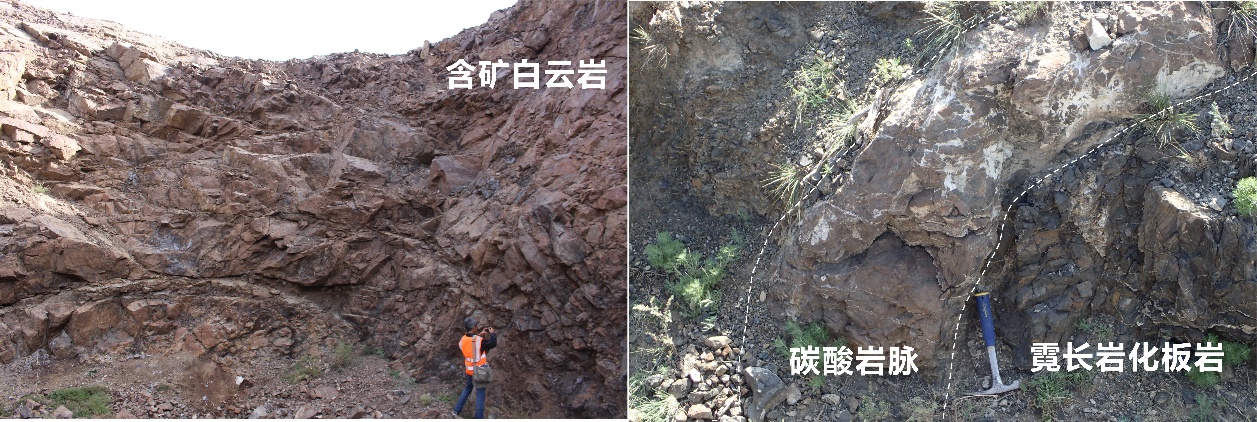
Figure: Ore-bearing dolomite (left) and carbonatite vein (right) fromin the Bayan Obo deposit.
Zuolinite occursis hosted in the fine-grained ore-bearing dolomite withinof the Bayan Obo deposit. It isexhibits a yellowish-brown to brown in color, exhibits with a vitreous luster, and formsoccurs as euhedral tabular crystals measuring approximately 20-–40 μm in size. The mineral has a measured density of 5.538 g/cm³ and is typically occurs as found in granular aggregates form associated with minerals such as magnetite, hematite, columbite, pyrite, and forsterite.
Zuolinite is a metallic oxide mineral with characterized by a previously unknownnovel chemical composition, dominated bywith barium, strontium, and niobium as its principal components. It contains an average Nb₂O₅ content of 52.9 wt.% and has, corresponding to the ideal chemical formula Ba2Sr(Nb4.5Fe3+0.5)O15. The mineral crystallizes in the tetragonal system and belongs to the space group P4/mbm (No. #127).
The mineral is named in honor ofafter He Zuolin, an academician of the Chinese Academy of Sciences and former researcher at the Institute of Geology, Chinese Academy of Sciences. Professor He is widely recognized as aone of the founders of modern mineralogy and petrology in China, and a pioneering figure in of rare-earth scientific research. In 1934, he first identifiedmade the pioneering discovery of two the rare-earth minerals (bastnasite and monazite) in ore samples from the Bayan Obo deposit, a discovery that. This groundbreaking finding laid thea solid foundation for China's development status as a major rare-earth resource nationcountry. Naming Zuolinite after Professor He honors his seminal scientificthe new mineral from the Bayan Obo deposit after Professor He is not only a high tribute to his academic contributions andbut symbolizes the continuity and inheritance of the spirit of rare-earth scientific research in China.
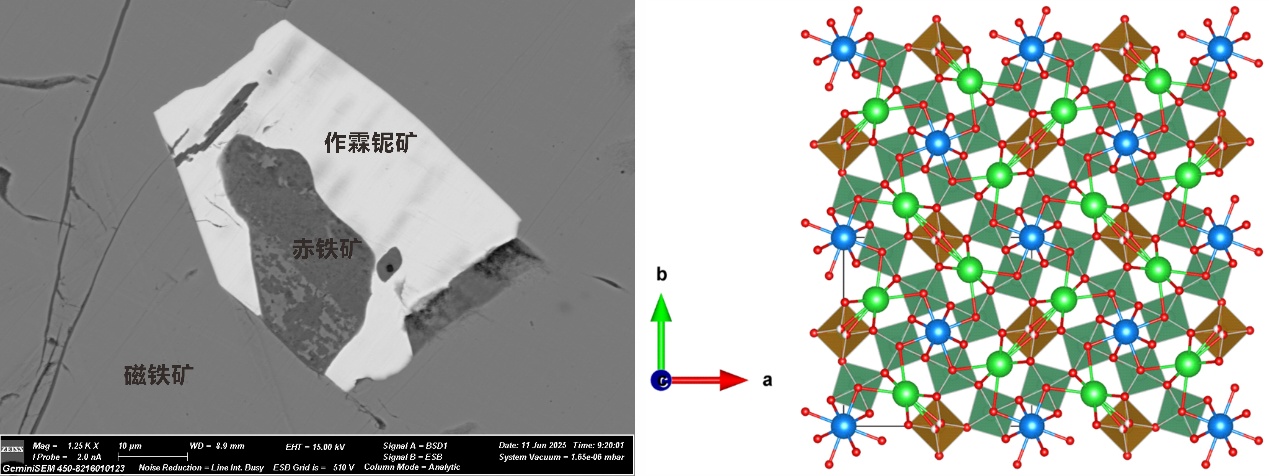
Figure: Microscopic images and crystal structure of Zuolinite.
Magnesiohongruiite-(Fe³⁺) occurs inis found within the carbonatite veins of the Bayan Obo deposit. It appears as reddish‑brown, tabular crystals with a vitreous luster, typically measuring ranging from 10- to 30 μm in size, and has. With a density of 4.453 g/cm³., The mineral is commonly occurs in associationed with oboniobite, pyrochlore, magnetite, and dolomite.
This mineral belongsing to the euxenite supergroup and, it is an oxide mineral containing hydroxyl water, with magnesium, iron, and niobium as its principal constituentsmain components. It has an average Nb₂O₅ content of 32.8 wt.% and , corresponding to the ideal chemical formula (Mg2Fe3+)NbFe3+O7(OH). Magnesiohongruiite-(Fe³⁺) The mineral crystallizes in the hexagonal system with space group P63mc (No. #186).
Theis mineral is named in honor ofafter Fan Hongrui, a researcher at the Institute of Geology and Geophysics, Chinese Academy of Sciences, in recognition of his long‑standing outstanding contributions toachievements in the study of carbonatite‑type rare‑earth deposits, hydrothermal gold deposits, and sedimentary copper‑cobalt deposits. Through systematic investigationsresearch ofn the Bayan Obo giant rare‑earth deposit, Fan Hongrui was the first to comprehensively elucidate the magmatic‑hydrothermal evolution of carbonatites and the associated rare-earth enrichment mechanisms of rare‑earth elements, thereby establishing a metallogenic and exploration model for this world‑class deposit. Under his leadership, the research team has successively discovered several new minerals fromin the Bayan Obo deposit, including Oboniobite (IMA 2023‑118a), Scandiobabingtonite (IMA 2024‑002), and Fuyuanite (IMA 2024‑059).
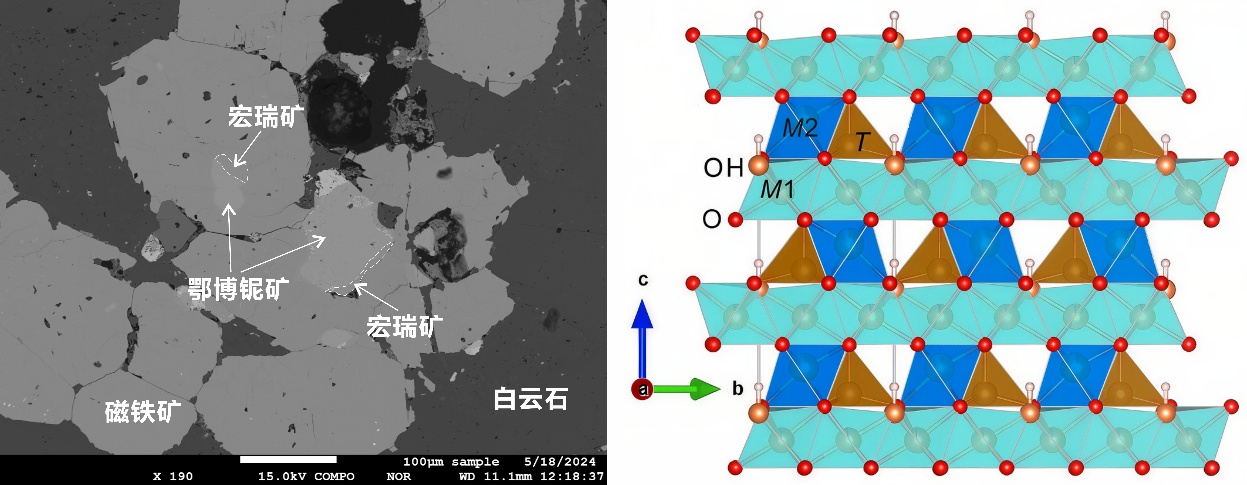
Figure: Microscopic images and crystal structure of Magnesiohongruiite-(Fe³⁺).


